DOES TOMORROW ALREADY EXIST? OR ARE WE TRAPPED IN AN ILLUSION OF THE MIND?
For centuries, humanity has grappled with a profound and unresolved conflict over the nature of existence. Traditional theology has often appealed to divine creation to explain how something could emerge from nothing. Meanwhile, scientific materialism has sought to explain the extraordinary order of the cosmos through physical processes, chance, and statistical probability.
What if both approaches overlook something fundamental?
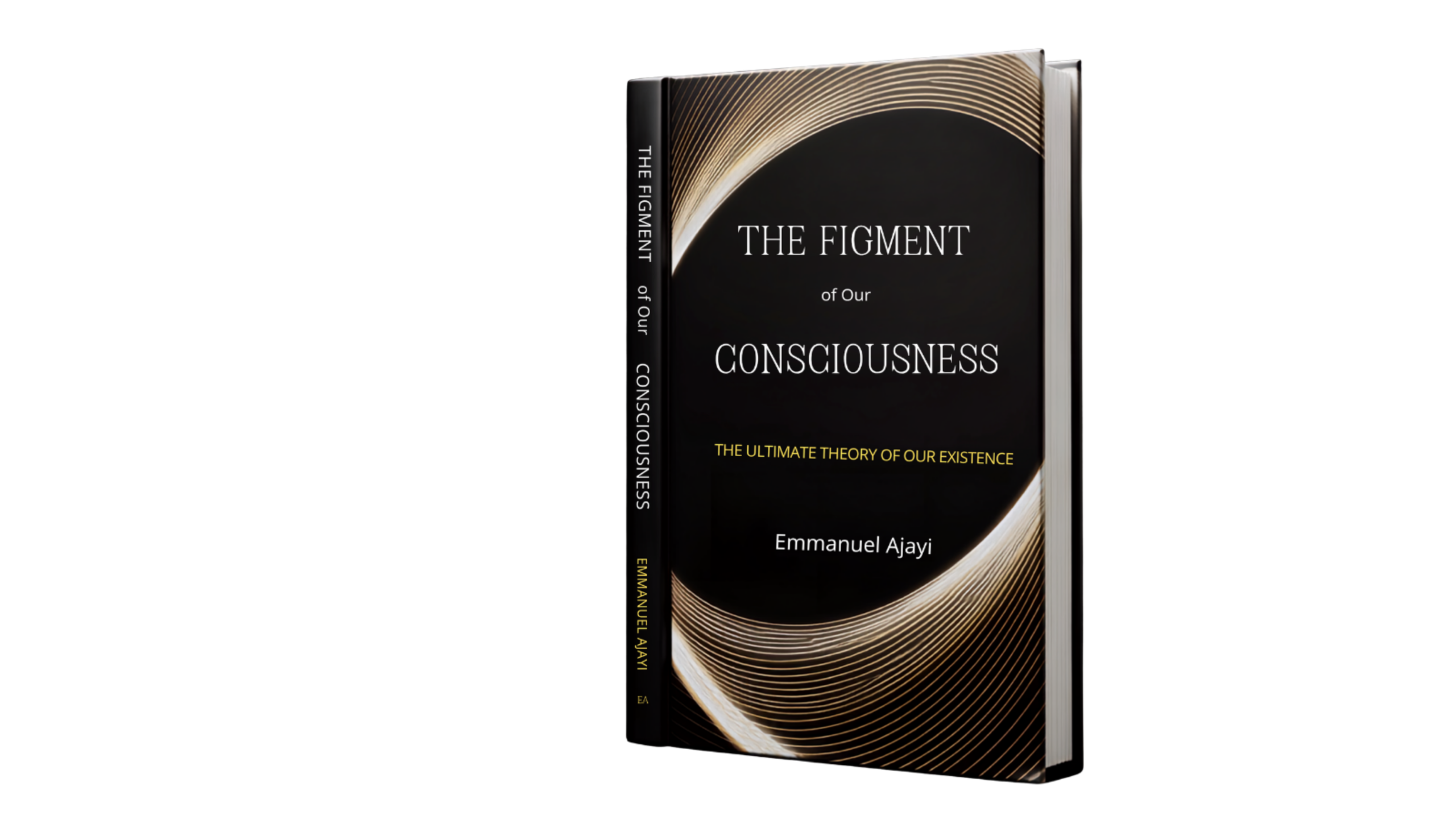
In The Figment of Our Consciousness, mathematical scientist and educator Emmanuel Ajayi challenges the assumptions underlying conventional accounts of creation, causality, and time. By examining the apparent beginnings of the universe and questioning the familiar intuition that time flows from past to future, Ajayi invites readers to reconsider the foundations upon which our understanding of reality rests.
Drawing on physics, philosophy, and his original Panpsychophysical Theory, he advances an alternative framework for understanding existence, consciousness, and the nature of reality itself. What if existence does not require an ultimate beginning? What if the passage of time, as we experience it, is not a fundamental feature of reality but an illusion arising from consciousness? These are not merely questions about the universe. They are questions about the very conditions that make experience—and our understanding of existence—possible.
Introducing Panpsychophysics
How might the probabilistic world of quantum mechanics relate to the large-scale geometry of Einsteinian spacetime? Can the apparent divisions between consciousness, physical reality, and the experience of time be understood within a single conceptual framework?
In The Figment of Our Consciousness, Emmanuel Ajayi introduces Panpsychophysical Theory (Panpsychophysics), his proposed framework for examining these questions. At its core is a radical proposition: the past, present, and future do not pass into one another but coexist as an invariant totality. From this perspective, what we experience as the passage of time may arise not from time itself flowing, but from the relationship between consciousness and the configurations of reality.
Objects do not move. Time does not pass. It is consciousness that flows. These propositions challenge familiar assumptions about motion, temporal succession, and the nature of experience, inviting readers to reconsider what it means for reality to exist.
The Journey Outside of Time
Across five interconnected chapters, The Figment of Our Consciousness moves from the origins of human curiosity to the deeper questions surrounding time, nothingness, and the nature of existence.
Chapter 1: The Awakening of Curiosity
Return to the origins of human wonder and examine how inherited beliefs shape our understanding of reality. Explore the interpretation of ancient texts, the development of human thought, and the evolutionary history that connects humanity to the natural world.
Chapter 2: The Illusion of Origin
Reconsider the theological argument for a First Cause and examine the assumptions underlying claims about the universe’s beginning. From the history of cosmic expansion to the limits of conventional cosmological explanations, this chapter introduces the Neutral Cosmological Principle.
Chapter 3: The Geometry of Time
Enter the conceptual territory of the block universe and challenge the intuition that time flows from past to future. Through the Lee Replicates-Seven Continents Paradox, Ajayi develops his account of how consciousness relates to static physical configurations and how our experience of history, motion, and free will may emerge.
Chapter 4: The Parametric Vacuum
Examine the distinction between an apparently empty vacuum and absolute nothingness. Drawing on questions raised by quantum field theory and the physical meaning of zero, this chapter explores whether nothingness can be understood as a genuinely absolute absence or whether the very concept conceals deeper assumptions about existence.
Chapter 5: The Cosmic Mirror
Bring the book’s central questions together through an exploration of human destiny, evolutionary psychology, and the architecture of religious thought. Ajayi develops his interpretation of existence as an integrated cosmic whole and examines the place consciousness occupies within that totality.
A Question Worth Exploring
What if our deepest assumptions about time, creation, and consciousness have obscured the very nature of existence?
The Figment of Our Consciousness: The Ultimate Theory of Our Existence invites readers to examine that possibility through an unconventional encounter with physics, philosophy, and metaphysics.
For readers willing to question familiar explanations and reconsider the foundations of reality, the journey begins here.