Panpsychophysics is a theoretical framework developed to explore the relationship between consciousness, physical reality, quantum multiplicity, classical continuity, and the apparent passage of time.
The theory begins with a fundamental question: What if consciousness is not merely something that occurs within reality, but part of the structure through which physically distinct states of reality are connected and experienced?
In The Figment of Our Consciousness, I develop Panpsychophysics as an attempt to reconsider the relationship between mind and matter, not by treating consciousness as a mysterious phenomenon that suddenly appears within an otherwise entirely non-conscious universe, but by examining consciousness as a fundamental continuity underlying physically distinct configurations of existence.
What Is Panpsychophysics?
The word Panpsychophysics combines the philosophical question of consciousness with the physical structure of reality.
Traditional panpsychism generally concerns the proposition that mentality or experience is fundamental to nature. Panpsychophysics takes this question in a more specific direction. It investigates how consciousness might relate to the different physical configurations that constitute reality and, in particular, how those configurations can be experienced as a continuous existence.
The central proposition is that physically distinct configurations of reality are not necessarily isolated entities. They may be interconnected within a deeper continuity, and consciousness is intrinsic to that continuity.
A physical system can occupy different states. A human being, for example, exists in an enormous succession of physically distinct configurations throughout biological life. The arrangement of the brain, body, surroundings, and information available to the individual changes continuously. Yet the individual experiences these different configurations as belonging to one continuous existence.
Panpsychophysics asks what makes this continuity possible.
Rather than assuming that consciousness simply travels through time from one physical state to another, the theory proposes that the relationship between the states themselves may generate the experience of succession.
The Problem: Multiplicity and Continuity
One of the central problems addressed by Panpsychophysics arises from the apparent contrast between quantum and classical descriptions of physical reality.
Quantum mechanics allows physical systems to be represented mathematically through superpositions and probability amplitudes. Classical physics, by contrast, describes macroscopic objects in terms of definite states and apparently continuous trajectories.
These descriptions are not simply two different universes. They are different physical descriptions applicable within different regimes. Yet their conceptual contrast raises an important question:
How can multiplicity and continuity belong to the same underlying reality?
Panpsychophysics proposes that what appears as multiplicity at one level of description may correspond to a sequence of related configurations at another.
In this interpretation, quantum multiplicity and classical continuity are not necessarily contradictory descriptions of two fundamentally different realities. They may represent different aspects of one underlying structure.
Consciousness as Continuity
The meaning of consciousness in Panpsychophysics is broader than ordinary psychological awareness.
When we ordinarily speak of consciousness, we mean subjective experience: seeing, hearing, thinking, remembering, feeling, and being aware of our surroundings.
Panpsychophysics does not deny this biological and psychological dimension. Instead, it asks what lies beneath it.
The theory treats consciousness as a fundamental continuity connecting physically distinct configurations.
Consider a sequence of configurations:
A → B → C → D
Each configuration is physically distinct. Yet if they are structurally related, they can constitute one continuous existence. Consciousness provides the continuity through which those distinct configurations are registered as belonging to one coherent identity.
The individual does not need to be imagined as a physical object literally traveling through an independently existing substance called time. Instead, the configurations themselves stand in ordered relationships, and consciousness experiences those relationships as succession. This distinction is central to Panpsychophysics.
The Illusion of Time
One of the most significant implications of Panpsychophysical Theory is its treatment of time.
We ordinarily experience reality as though it were continuously moving from the past, through the present, and toward the future. Yesterday seems to have disappeared, today seems to be occurring now, and tomorrow seems not yet to exist.
Panpsychophysics challenges the assumption that this experience necessarily reflects the fundamental structure of reality.
Suppose reality consists of a collection of physically distinct configurations:
A → B → C → D
Configuration A differs from B, B differs from C, and C differs from D. If consciousness registers these configurations according to their structural relationships, the result is an experience of succession.
The configurations themselves do not need to move through time. Their differences and relationships are sufficient to produce an ordered experience.
From this perspective, the passage of time may be a feature of consciousness rather than a fundamental property of reality.
This does not mean that clocks are meaningless or that physical processes do not occur. It means that the measurable relationships between physical states may not require an independently existing substance called time.
What we call temporal flow may instead be the sequential registration of physically related configurations.
The Lee Replicates–Seven Continents Paradox
To illustrate this idea, I developed a thought experiment called the Lee Replicates–Seven Continents Paradox.
Imagine seven identical versions of one individual, Lee, simultaneously occupying the seven continents:
Lee A — Asia Lee B — Africa Lee C — North America Lee D — South America Lee E — Antarctica Lee F — Europe Lee G — Australia
Now imagine that all seven versions are connected to one shared consciousness.
If the seven versions were perfectly identical in physical state, there would be no internal difference by which consciousness could distinguish one configuration from another. The seven perspectives would therefore be conceptually simultaneous. There would be no meaningful experience of “before” and “after” because nothing would distinguish one state from another.
Now introduce a difference.
Suppose Lee A is the youngest, Lee B is one day older, Lee C is one day older still, and so forth. The seven configurations are now physically distinguishable. Each contains different information and corresponds to a different state within the structure.
The result is an ordered relationship.
Although the configurations can be considered part of one larger structure, consciousness experiences their differences as succession. What is structurally simultaneous can therefore be experienced sequentially.
The thought experiment illustrates the central idea of Panpsychophysics:
Temporal experience emerges from the ordered registration of differences between related physical states.
From Quantum Multiplicity to Classical Motion
The same principle can be applied to the concept of motion.
Consider a physical entity associated with two different spatial configurations. Quantum mechanics can describe a system through a spatially distributed wave function and multiple possible outcomes. Classical physics, under appropriate conditions, describes an object as occupying a definite position and moving continuously from one position to another.
Panpsychophysics proposes that these descriptions can be interpreted as different representations of an underlying relational structure.
At one level, we have distinct configurations.
At another, we experience those configurations as a continuous trajectory.
The transition from one state to another does not necessarily require an object to move through a separate substance called time. Instead, the physically related configurations constitute the structure, while consciousness registers them as succession.
Thus, what we call motion can be understood as the ordered registration of distinct but connected physical states.
The Uncertainty Principle and the Observer Effect
Panpsychophysics does not depend on the common misconception that consciousness causes quantum uncertainty simply because a human observer looks at a physical system.
The Heisenberg uncertainty principle and the observer effect are distinct concepts.
The uncertainty principle concerns fundamental limits on the simultaneous precision with which certain pairs of physical quantities, such as position and momentum, can be specified. The observer effect concerns situations in which measurement or physical interaction alters a system.
Quantum measurement does not require a conscious human observer. A physical interaction between systems can constitute a measurement process.
This distinction is important to Panpsychophysics because the theory does not claim that human awareness creates physical reality.
Instead, it asks a different question:
What does the mathematical structure of physical reality imply about the relationship between physically distinct states and conscious experience?
Panpsychophysics treats consciousness as fundamental to the continuity connecting states, not as a human intervention that magically produces those states.
Panpsychophysics and the Multiverse
Popular culture often portrays the multiverse as an enormous collection of disconnected worlds in which every conceivable version of an individual lives a different life.
In one universe, a person becomes a doctor. In another, a lawyer. In another, a politician. In another, an engineer.
Panpsychophysics proposes a fundamentally different perspective.
Rather than imagining reality as an infinite collection of isolated biographies, we can consider different physical configurations as elements of one larger structure. The relevant question is therefore not simply how many universes exist, but how the configurations that constitute reality are related.
Under this framework, what we call the past, present, and future can be interpreted as different configurations within the total structure of existence.
The past does not necessarily have to cease existing merely because consciousness no longer occupies that configuration, just as the future does not necessarily have to be created from nothing when consciousness eventually encounters it.
Reality may therefore be far more extensive than the single sequence available to an individual observer.
Panpsychophysics and Personal Identity
This framework also changes how we think about personal identity.
You are not physically identical to the person you were ten years ago. Your body has changed, your brain has changed, your memories have changed, and your environment has changed. Yet you experience yourself as one continuous individual.
Panpsychophysics interprets this continuity as something deeper than the persistence of an unchanged physical object.
Different physical configurations can belong to one continuous identity because they are structurally related. Consciousness is what makes these differences experientially coherent.
The person who existed yesterday and the person who exists today are therefore not literally the same physical configuration. They are different configurations belonging to one continuous structure of conscious existence.
This provides another way of understanding why personal identity persists despite constant physical change.
Panpsychophysics vs. Traditional Panpsychism
Panpsychophysics should not simply be equated with traditional panpsychism.
Panpsychism is a broad philosophical family of views concerning the fundamentality or ubiquity of mentality or experience in nature. Panpsychophysics takes that philosophical problem and connects it to a specific account of physical configurations, continuity, consciousness, and temporal experience.
The distinction can be stated simply:
Panpsychism asks whether consciousness or experience is fundamental to reality.
Panpsychophysics asks how consciousness, understood as a fundamental continuity, relates to the physically distinct configurations that constitute reality and to the experience of succession, motion, and time.
The purpose is therefore not merely to claim that everything is conscious. Panpsychophysics is concerned with the structural relationship between consciousness and physical existence.
Is Panpsychophysics Established Physics?
No.
Panpsychophysics is a theoretical and philosophical framework developed in The Figment of Our Consciousness. It is not presented as an experimentally established physical theory, nor as a replacement for quantum mechanics, relativity, or classical physics.
The established mathematical and experimental results of modern physics remain what they are.
Panpsychophysics instead asks whether those results can be interpreted within a broader philosophical framework in which consciousness is fundamental to the continuity connecting physically distinct configurations.
Where established physics ends and philosophical interpretation begins, the distinction should remain explicit.
The value of the theory therefore does not depend upon pretending that its propositions have already been experimentally confirmed. Its purpose is to propose a conceptual framework and to investigate whether that framework can provide a coherent account of questions that remain deeply unsettled at the intersection of physics, philosophy, consciousness, and existence.
The Central Proposition
Panpsychophysics can ultimately be expressed through a single proposition:
Reality consists of physically distinct but fundamentally interconnected configurations, while consciousness provides the continuity through which those configurations are experienced as an ordered succession.
From this proposition follows a broader interpretation of existence.
What we experience as time may be the ordered registration of configurations.
What we experience as motion may be the succession of physically related states.
What appears as multiplicity may belong to one unified structure.
What we experience as a continuous self may be the conscious continuity connecting different physical configurations.
And what appears to be a universe continually becoming something else may instead be a complete structure experienced locally and sequentially by consciousness.
Panpsychophysics and The Figment of Our Consciousness
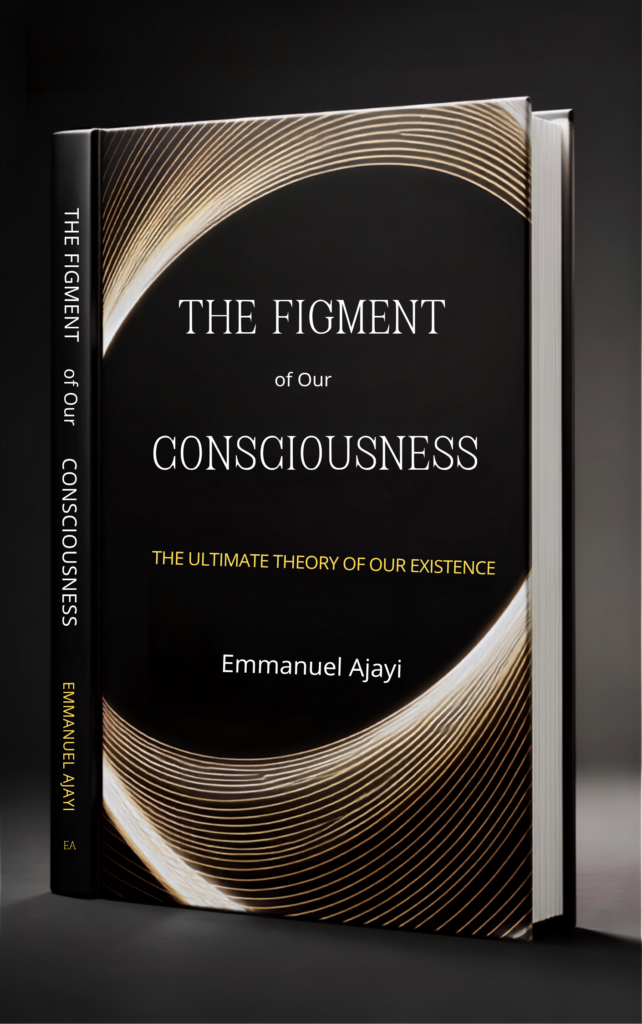
Panpsychophysics is the theoretical framework at the heart of The Figment of Our Consciousness.
The book explores the possibility that our ordinary experience of reality conceals a deeper structure in which consciousness, existence, time, and physical configuration are fundamentally interconnected.
Panpsychophysics is not offered as the final word on these questions. It is an invitation to reconsider the assumptions through which we interpret existence.
The central question is ultimately simple:
Why are you conscious of this reality—and not another?
Perhaps the answer lies not in the existence of countless disconnected worlds, but in the structure of consciousness itself.
Perhaps reality is not moving through time.
Perhaps consciousness is moving through configurations.
And perhaps what we call existence is the experience of a structure that, at its deepest level, simply is.
Explore the theory further
Read The Figment of Our Consciousness: The Ultimate Theory of Our Existence
Explore the complete development of Panpsychophysics and its implications for consciousness, time, quantum reality, and existence.