Why observation selection cannot explain cosmic fine-tuning without presupposing the structure it seeks to explain.
A profound intellectual evasion dominates modern secular cosmology when it attempts to address why our universe appears to be so exquisitely calibrated to support the existence of self-conscious life. In his landmark 1983 work The Intelligent Universe, the renowned astrophysicist Fred Hoyle explicitly acknowledged this phenomenon, noting that the list of anthropic properties—apparent accidents of a non-biological nature without which carbon-based and hence human life could not exist—is remarkably large and impressive. Decades before Hoyle’s writing, the physicist Robert H. Dicke had rigorously demonstrated that the fundamental forces of nature, most notably the electromagnetic force and the gravitational force, must be perfectly and intricately balanced in relation to one another for biological entities to exist anywhere in the cosmos. Stephen Hawking similarly advanced this discourse, proving that the physical universe would have been radically and unrecognizably different supposing the size of the electric charge of the electron and the precise ratio of the masses of the proton and the electron had been even microscopically different from what we calculate in our laboratories. Faced with this staggering precision, contemporary materialists are forced to invent an escape hatch to avoid the implication of cosmic intent. They retreat into the anthropic principle, or the observation selection effect, a hypothesis originally proposed by Dicke in 1957. This model posits a massive multiverse where unnumbered worlds run on widely differing physical constants. Proponents argue that we should not be surprised by our universe’s exquisite fine-tuning, because only in a rare, lucky branch with the right parameters could self-conscious observers emerge to look at the night sky in the first place.
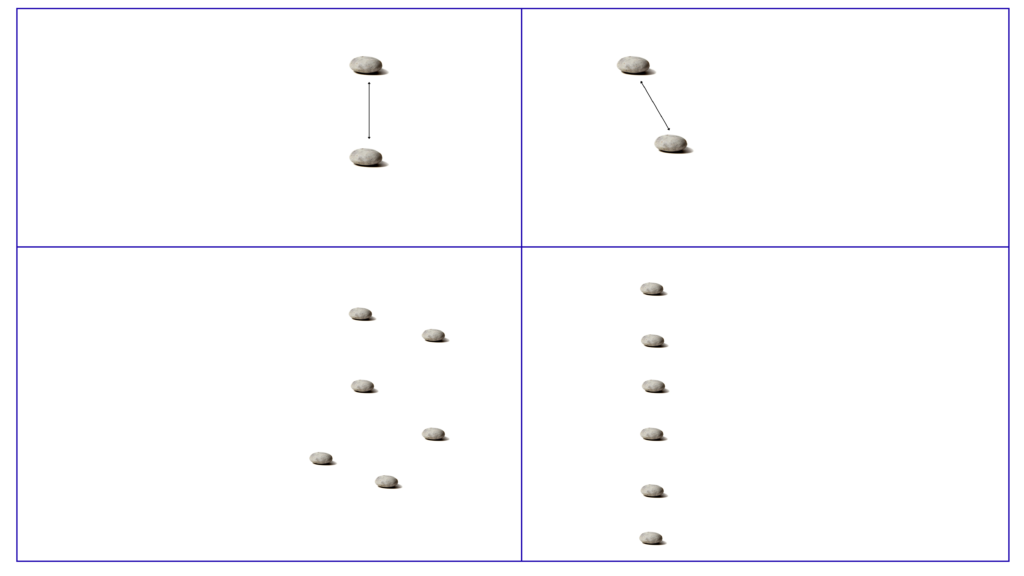
When subjected to strict mathematical and logical analysis under the principles of Panpsychophysics, this entire anthropic framework is revealed to be a statistical mirage. Physical existence cannot transpire by random accident, chaotic fluctuations, or statistical happenstance, which is the direct, unexamined implication of the anthropic model. To expose the mathematical bankruptcy of this selection effect, let us construct a precise probability analogy involving the trajectory of physical objects. Suppose two raw rocks are thrown into the air simultaneously. Because any two independent points in space can always be connected by a single straight line, these two rocks will inevitably line up with absolute geometric perfection on each and every occasion when they land upon the earth. Hence, the probability that exactly two rocks will land perfectly lined up on the ground on each occasion when they are thrown is one. This infers that there is an absolute 100 percent chance that the two rocks will land in a straight line every single time they are thrown. However, the probability that a larger number of rocks will land perfectly lined up on a single occasion, if thrown a multitude of times, rapidly approaches or becomes zero the moment more than two rocks are introduced to the system. The mathematical probability drops to an absolute zero if infinitely many rocks are thrown simultaneously, because the greater the number of independent variables introduced, the lesser their mathematical chances of landing in a pristine, ordered arrangement. There is a zero percent chance that a massive collection of scattered rocks will land lined up if a large number of rocks are thrown. The only possible way one can get a large number of rocks to form a straight line upon the earth is for a conscious agent to physically line them up by hand.
In much the exact same manner that it is a mathematical impossibility for an infinite number of random rocks to land lined up in a straight line even when thrown an infinite number of times, except an agent lines them up, so it is an absolute impossibility that a random sort of existence could permit the being of self-conscious life even across an infinite number of alternative universes, except there is an underlying structure of destiny. The Christian philosopher Alvin Plantinga raises a similar critique against materialist cosmology, demonstrating that to claim one single universe out of an infinite multitude happened to permit the being of intelligent life by random chance merely raises the question as to why our specific universe could be so incredibly fortunate as to host the exact conditions required to support life on Earth. Plantinga proves that it is profoundly unlikely for an anthropic universe to happen by blind chance, but rather structurally inevitable if there is an underlying law of consciousness. The theoretical physicist John Polkinghorne expresses an identical view, noting that anthropic fine-tuning is far too remarkable to be dismissed as just a happy statistical accident. Furthermore, the cosmologist Paul Davies argued against the anthropic principle by pointing out that invoking an infinity of invisible, unseen universes to explain the unusual features of the one universe we can see is just as unscientific and ad hoc as invoking an unseen creator.
The baseline truth is that the meaning of existence has absolutely nothing to do with random happenstance or the localized lifespan of the physical universe. Reality is a permanent, defined, and invariable baseline. The fact that existence actively supports intelligent life substantiates that consciousness is the absolute fundamental bedrock to the being of the entire universe. We must come to terms with the reality that biological life is not meant for fun or accidental survival, but for mere experience across a frozen, coexisting multiverse. Existence is ultimately a grand, natural movie in which every single entity plays its assigned part as a character with absolute, one-accord unity, and a movie is completely aimless if it cannot be observed by an audience. The universe does not exist by a happy accident; it exists because defined existence is a structural inevitability, and it supports intelligent life because it exists fundamentally to be witnessed and observed.