
Exploring the Relationship Between Consciousness, Physical Reality, and the Apparent Passage of Time
Panpsychophysics, or Panpsychophysical Theory, is the theoretical framework I developed to explore one of the most difficult questions in philosophy and physics: how does consciousness relate to the fundamental structure of reality?
The question is not simply whether human beings are conscious. We know from direct experience that we are. The deeper question is why consciousness exists at all, how it relates to the physical universe, and whether the experience of time and change tells us anything about reality itself. Panpsychophysics approaches these questions by proposing that consciousness should not be treated merely as a secondary phenomenon that appears after matter becomes sufficiently complex. Instead, consciousness is fundamental to the way physical configurations of reality are related and experienced.
The term panpsychism already has a long history in philosophy. In contemporary philosophy of mind, panpsychism is generally understood as the view that mentality is a fundamental and ubiquitous feature of the natural world. Different versions of panpsychism make different claims about what kinds of entities possess mentality and what “consciousness” means at the fundamental level. Panpsychophysics, as I use the term, should not simply be regarded as another name for traditional panpsychism. It is an attempt to develop a broader framework in which consciousness, physical configuration, and the apparent structure of time are considered together.
At the center of Panpsychophysical Theory is a simple but radical proposition: reality may consist fundamentally of configurations rather than things moving through an independently existing time.
Consider the physical state of a person at two different moments. You at one moment are physically different from you at another. Your brain has changed, your body has changed, your surroundings have changed, and the information available to you has changed. Yet you experience these different states as belonging to one continuous existence. Ordinarily, we explain this continuity by saying that you existed at one moment, then time passed, and you subsequently existed in another.
Panpsychophysics questions whether this description is fundamental.
Instead, imagine reality as consisting of an immense set of physical configurations. Each configuration has a particular arrangement of matter, energy, information, and relationships. A conscious organism corresponds to particular configurations within this larger structure. The configuration itself is static, but the conscious experience associated with related configurations produces what we perceive as succession.
This gives us a different way of thinking about time.
Rather than assuming that consciousness moves through an independently existing substance called time, Panpsychophysics proposes that what we call the passage of time may emerge from the relationship between consciousness and successive physical configurations. The experience of yesterday, today, and tomorrow would then represent different relations between consciousness and the configurations constituting reality.
One of the central ideas explored through Panpsychophysics is that time may not exist fundamentally in the way we ordinarily imagine it.
This does not mean that clocks are meaningless or that physical processes do not occur in measurable sequences. Clocks change state, biological organisms change state, planets change position, and physical systems evolve according to describable relationships. What is being questioned is something more fundamental: whether an additional entity called “time” is required to explain those changes.
Suppose reality consists of configurations A, B, C, and D, arranged according to structural relationships. A conscious system associated with A experiences A. A related configuration B contains the physical conditions associated with what we would call the next moment. The system associated with B contains information about A, while C contains information about B, and so forth. From inside the system, this arrangement produces an unmistakable experience of continuity.
Nothing about this necessarily requires a universal substance called time to flow from one configuration to another.
The analogy of a film is useful, although imperfect. A film consists of individual frames. Each frame is static, yet an observer experiences movement when the frames are presented in an ordered relationship. The motion does not exist as a moving object inside any individual frame; it arises from the relationship between the frames and the observer’s experience of them.
Panpsychophysics applies a similar intuition to reality, while taking the idea much further. The configurations of reality constitute the structure, while consciousness provides the experiential continuity through which related configurations appear as a succession.
This leads to an important distinction between consciousness as a property of a particular state and consciousness as the continuity connecting states.
A human brain changes continuously throughout biological existence. Yet we do not experience every physical configuration as an entirely unrelated individual. We experience ourselves as one persistent identity. The person who wakes up tomorrow regards himself as the same person who went to sleep tonight, despite the fact that his physical configuration has changed.
Panpsychophysics interprets this continuity in a fundamentally different way. Consciousness is not necessarily something that belongs exclusively to one isolated configuration. Instead, it represents an invariant identity associated with a succession of structurally related configurations.
Consider a sequence of states:
A → B → C → D
Each state is physically distinct, but the conscious identity associated with the system remains continuous across the sequence. The sequence therefore does not require consciousness to travel through time like an object moving through space. The conscious experience is generated by the relationship among the configurations themselves.
This provides a possible conceptual bridge between the static structure of reality and the dynamic character of experience.
Panpsychophysics is not presented as a replacement for established physics. Rather, it is a philosophical and theoretical framework that asks whether the mathematical descriptions provided by physics can be interpreted differently when consciousness is treated as fundamental.
Modern physics already challenges many ordinary assumptions about reality. Relativity replaces the idea of absolute universal time with spacetime, while quantum mechanics provides a description of physical systems that differs profoundly from classical intuitions. These theories are extraordinarily successful within their respective domains, yet they do not by themselves provide a complete philosophical explanation of why subjective experience exists.
This is where Panpsychophysics attempts to enter the discussion.
The theory asks whether the apparent separation between physical reality and consciousness is partly a consequence of how we conceptualize both. If physical reality is fundamentally described through structures, relations, states, and mathematical configurations, then perhaps consciousness represents something intrinsic to the existence and continuity of those configurations rather than a phenomenon that appears inexplicably at a late stage of biological evolution.
This is related to questions that have motivated contemporary interest in panpsychism and related approaches to the philosophy of mind. One attraction of panpsychist approaches is precisely the attempt to avoid treating consciousness as something that mysteriously emerges from a reality that was completely devoid of mentality.
Panpsychophysics takes this problem in a particular direction: instead of asking only whether consciousness exists at fundamental levels of reality, it asks how consciousness might relate to the structural continuity of physical configurations and to our experience of time.
This distinction is important because Panpsychophysics should not be reduced to the claim that “everything is conscious.”
That formulation is too crude to capture the theory.
The central question is not whether a rock thinks, whether an electron has human-like emotions, or whether every object possesses a miniature human mind. Those interpretations misunderstand the problem. Contemporary discussions of panpsychism themselves distinguish between consciousness or experience and sophisticated forms of cognition such as reasoning, belief, and desire.
Panpsychophysics is concerned with something more fundamental: the relationship between consciousness and the configurations that constitute physical existence.
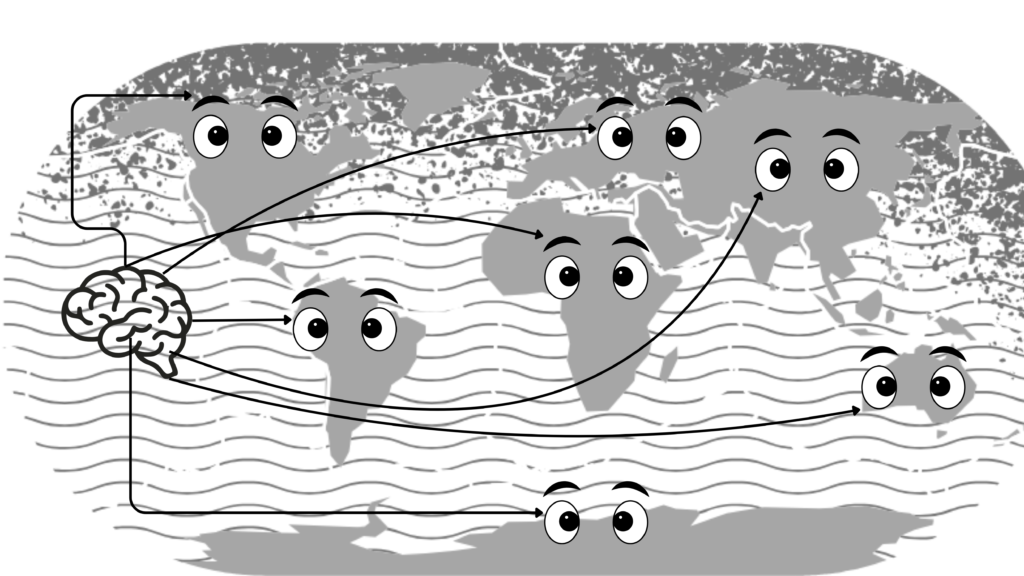
The human brain provides the clearest example because it is a highly organized physical system capable of generating extraordinarily rich experiences. But the theory does not begin by assuming that consciousness is simply an accidental product of the brain. Instead, it asks whether the brain should be understood as the particular physical structure through which a more fundamental property of reality becomes organized into the unified experience we recognize as consciousness.
The brain, in this interpretation, does not necessarily create consciousness from absolute non-consciousness. It provides the particular structure through which consciousness becomes localized, ordered, and richly differentiated.
The significance of Panpsychophysical Theory ultimately extends beyond the question of consciousness itself. If consciousness is fundamental to the relationship between physical configurations, then several familiar assumptions about existence require reconsideration.
Time may not be a fundamental entity but an experiential ordering of configurations. Personal identity may not consist of a single physical object persisting unchanged through time but of a continuity connecting different physical states. The apparent movement of reality may belong to consciousness rather than to reality itself. And what we ordinarily call “the present” may simply be the configuration currently accessible to a particular conscious system.
This perspective also changes the way we think about the universe as a whole. Instead of imagining existence as something that is continually coming into being, Panpsychophysics allows us to consider the possibility that reality is fundamentally complete, with conscious observers experiencing localized portions of its structure in sequence.
The implications are profound.
If the universe is a complete structure rather than a process continually being created, then existence does not need to “arrive” at the present moment. The past does not necessarily have to disappear, and the future does not necessarily have to wait for its existence. What changes may be our relation to the configurations of reality rather than reality itself.
Panpsychophysics therefore represents an attempt to rethink one of the oldest philosophical problems from an unusual direction. Rather than beginning with the assumption that matter is fundamental and consciousness somehow appears within it, or assuming that consciousness is fundamental and the physical world is merely an appearance, the theory investigates whether consciousness and physical structure can be understood as inseparably connected aspects of one underlying reality.
This is the broader philosophical project behind Panpsychophysical Theory as developed in The Figment of Our Consciousness. The theory proposes that what we experience as a universe moving through time may actually be a permanent structure experienced sequentially by consciousness. Reality may not be something that is continually becoming. It may simply be something that is—while consciousness gives us the extraordinary experience of becoming.
Brilliant idea!
Thank you, Eddie.