Why modern physicists and popular culture completely misinterpret the true mathematical architecture of the block universe.
A profound misconception has become embedded in contemporary discussions of the multiverse, particularly in popular physics and science fiction. The average science enthusiast is likely to imagine the multiverse as an enormous collection of parallel universes in which every conceivable version of human existence unfolds independently. In one universe, an individual named Lee becomes a celebrated medical doctor; in another, he becomes a criminal lawyer; in another, he becomes the president of a nation; and in yet another, he becomes a mechanical engineer. The same logic is then extended indefinitely: there is supposedly a universe in which Lee is born American, another in which he is Japanese, another in which he is Chinese, and another in which he is South African. Every decision, accident, historical event, or unrealized possibility is imagined to generate another independent reality in which an alternative version of existence is played out. I regard this popular conception as a form of multi-existence—the belief that reality consists of countless detached worlds containing different biographies of the same individuals. It is an appealing narrative, and science fiction has made it extraordinarily intuitive, but its intuitive appeal should not be confused with a rigorous description of the mathematical structure of reality.
The problem becomes particularly apparent when the popular conception of the multiverse is combined with ideas about time travel. Prominent physicists, including Michio Kaku, have discussed scenarios in which an observer travels backward in time and changes a historical event, thereby producing a separate timeline. In such a scenario, an individual might travel into the past and prevent the assassination of Abraham Lincoln, while the original universe continues to contain a history in which Lincoln was assassinated. The surviving Lincoln would therefore belong to a newly generated parallel universe, while the dead Lincoln would remain part of the original one. As a fictional thought experiment, this is perfectly intelligible. However, it encourages a particular mental picture of reality: one in which the universe is continually splitting into independent branches whenever circumstances permit alternative outcomes. That picture should not be casually identified with the mathematical implications of relativity or with every interpretation of quantum mechanics. The concept of a multiverse is not synonymous with an infinite collection of cinematic parallel worlds, and the distinction matters if we are attempting to understand the underlying architecture of existence rather than merely constructing imaginative scenarios.
A fundamentally different picture emerges when reality is considered from the perspective of the block universe. In the relativistic conception of spacetime, events are not necessarily arranged in a universe that is continuously being created in the present and subsequently destroyed into the past. Spacetime can instead be represented as a four-dimensional structure in which events occupy definite positions within the total geometry. The past does not have to be regarded as something that has ceased to exist, any more than the future has to be regarded as something that has not yet acquired existence. The distinction between past, present, and future may instead describe the way an observer is situated within spacetime and the manner in which information is processed by a physical consciousness. What we experience as the passage of time is therefore not automatically evidence that reality itself is moving from one ontological state into another. The universe may be structurally complete even though conscious organisms experience its configurations sequentially.
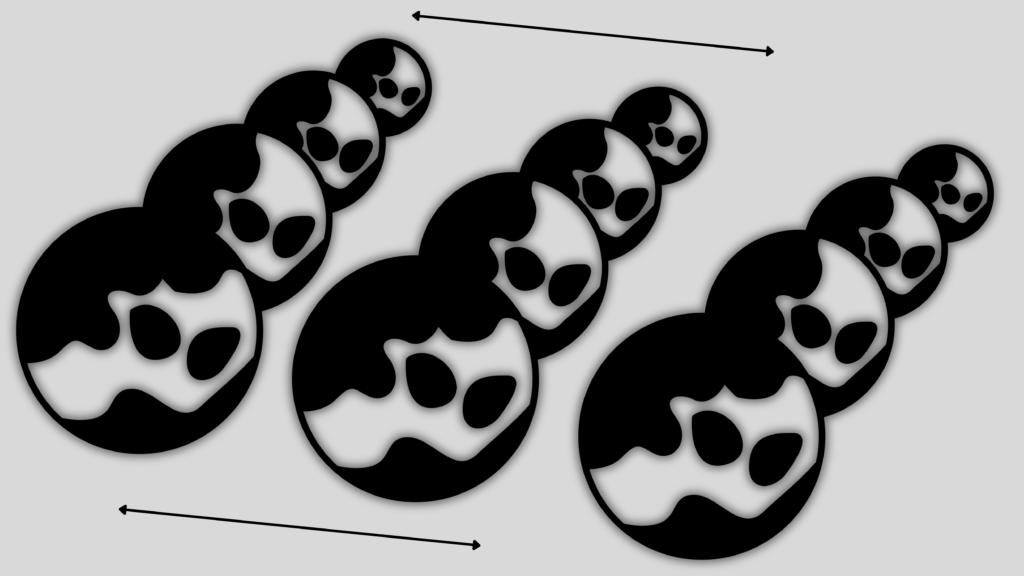
This changes the meaning of what is often called an alternative universe. Suppose, for example, that during the complete physical history of my existence there is a configuration in which I am a medical doctor, another in which I am unemployed, and another in which I occupy an entirely different stage of my biological life. The popular multiverse narrative encourages us to imagine separate universes containing different versions of me who have independently followed different paths. But if these states belong to the actual physical history of my existence, they need not be interpreted as independent universes at all. They can instead be understood as distinct configurations within the complete structure of reality. A configuration corresponding to my existence in 2024 is one part of that structure; a configuration corresponding to my existence in late 2026 is another; configurations corresponding to later stages are others. They do not have to be continually manufactured as the clock advances. They are coordinates within the total architecture. The version of me corresponding to late 2026 experiences the physical conditions associated with late 2026, while the version corresponding to 2024 is associated with the physical conditions of 2024. Neither configuration has to travel physically into the other for the total structure to contain both.
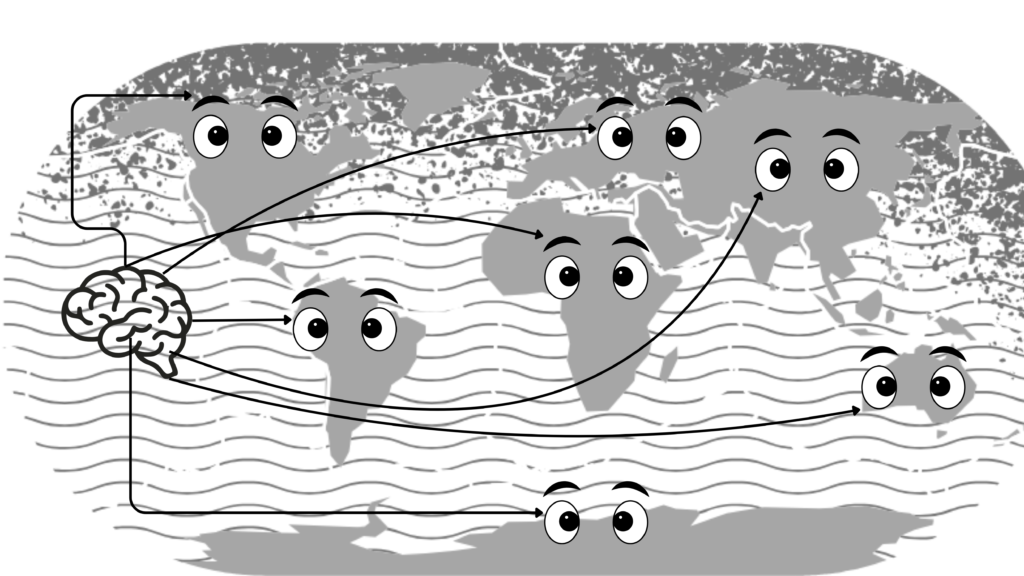
The same principle applies to every conscious observer. A configuration corresponding to you exists in relation to its own physical state, just as a configuration corresponding to me exists in relation to mine. Other configurations correspond to later or earlier states. Yet each localized consciousness has access only to the information encoded within its own physical configuration and its immediate relations to other configurations. I cannot, while writing this essay in late 2026, simultaneously perceive the complete physical configuration associated with my existence in 2024. The earlier configuration contains the biological and informational conditions appropriate to that state, while the later configuration contains those appropriate to the later state. From within any individual configuration, consciousness therefore encounters reality locally. The totality may contain a far larger structure, but the observer experiences only the portion accessible through its particular physical organization. This limitation of perception is precisely what makes the universe appear to unfold through time.
Here lies the conceptual foundation of my Panpsychophysical Theory. If reality consists of a complete set of physical configurations rather than a universe that is literally being generated from moment to moment, then we need an explanation for why conscious beings experience those configurations as a continuous sequence. Panpsychophysics proposes that consciousness is not merely an incidental property that appears after matter reaches a sufficient level of complexity. Instead, consciousness provides the fundamental continuity through which distinct physical configurations can belong to one coherent existence. The configurations are not isolated islands. They are related manifestations of an underlying reality, and the conscious system experiences them according to the structural relations connecting one configuration with another. What appears to be temporal movement is therefore the sequential experience of physically related states rather than the literal movement of reality itself through an independently existing substance called time.
This perspective also provides a different way of thinking about the apparent tension between quantum mechanics and classical descriptions of physical reality. Quantum mechanics describes physical systems through probability amplitudes and wave functions, while classical mechanics provides an intuitive description in terms of definite states and continuous trajectories. The familiar image of a particle existing in several possible locations appears radically different from the classical picture of an object occupying a particular location and moving continuously through space. Yet the difference does not necessarily require us to imagine an infinite number of disconnected universes, each containing a different particle. The distinct possibilities represented by the mathematical description can instead be considered in relation to the complete structure of physical reality. Under Panpsychophysics, the various configurations of a system are not arbitrary worlds floating independently in an external void; they are related states within a unified architecture whose continuity is fundamentally conscious.
The popular multiverse therefore becomes considerably less exotic once we remove the science-fiction imagery surrounding it. We do not need an infinite collection of universes in which every conceivable decision is independently enacted. We do not need a universe in which every person simultaneously becomes every possible version of themselves. Nor do we need to imagine reality as a tree endlessly branching whenever a decision is made. Such imagery treats possibilities as though every mathematical possibility must automatically become an independently existing physical world. But possibility and existence are not necessarily identical. A physically instantiated configuration belongs to reality because it is part of the structure of existence; an unrealized possibility does not become real merely because we can imagine it. The universe does not have to contain every conceivable biography simply because human beings can describe those biographies.
The distinction is particularly important when considering personal identity. If I become a doctor during the physical history of my existence, then the configuration in which I am a doctor belongs to that history. If I never become a doctor, there is no reason to invent another universe merely to accommodate the hypothetical version of me who did. Likewise, if I become president, that configuration does not require an independently existing universe containing a separate Emmanuel who followed a different metaphysical path. It can simply be another state within the total structure, provided that such a state is actually realized. The multiverse, in this sense, is not a warehouse containing every imaginable possibility. It is the totality of physically instantiated configurations that constitute reality.
This leads to a much more radical conclusion about time itself. If the configurations constituting reality are permanently embedded within its complete structure, then the sensation that reality is continually moving from an existing present toward an uncertain future, while the past recedes into non-being, may be a feature of consciousness rather than a fundamental property of reality. The brain exists in particular physical configurations, and those configurations contain records of other configurations. Memory gives us an apparent past; perception gives us an apparent present; anticipation gives us an apparent future. The resulting sequence is so fundamental to biological experience that it seems impossible to distinguish the experience of temporal passage from time itself. Yet the two may not be identical. Consciousness may be what transforms a static structural relationship between physical states into the dynamic experience we call time.
The consequence is a conception of reality very different from the multiverse portrayed in popular culture. Reality is not necessarily an infinite collection of disconnected worlds competing with one another, nor is it a cosmic machine continuously generating new universes every time an alternative possibility appears. It can instead be understood as one comprehensive structure containing the configurations that constitute existence, with consciousness providing the continuity through which those configurations are experienced as succession. What appears to us as an unfolding universe may therefore be a localized experience of a structure that, at the fundamental level, does not unfold at all.
The universe, under this interpretation, is less like an unfinished story being written sentence by sentence and more like a complete mathematical architecture whose configurations are experienced one after another by conscious observers. We do not create the next moment merely by reaching it. We experience another configuration of the structure. We do not destroy the previous moment by leaving it. We simply cease to occupy that configuration from the perspective of our immediate conscious experience. The past, present, and future are therefore not necessarily three different kinds of existence. They may be different relations between consciousness and the configurations that constitute reality.
The multiverse is consequently not the fantastical proliferation of alternative human biographies that popular culture has taught us to imagine. The deeper question is not how many imaginary universes can be generated from our choices, but how the apparently successive configurations of one reality relate to consciousness. Once that question is placed at the center of the discussion, the multiverse ceases to be merely a science-fiction spectacle and becomes part of a much more profound inquiry into the mathematical architecture of existence itself. Reality may not be a collection of countless worlds at all. It may be one complete structure, experienced locally and sequentially by consciousness, in which what we call time, change, and alternative existence emerge from our particular position within the whole.
The cosmos, then, is not an accidental explosion of endlessly diverging realities. It is an integrated and permanent structure—a vast tapestry of configurations whose apparent motion may belong not to reality itself, but to the consciousness through which reality is experienced. What we call the passage of time may be the experience of succession; what we call alternative worlds may be distinct configurations of one total existence; and what we call the multiverse may ultimately be something far more unified than the fragmented collection of parallel realities imagined by science fiction.